Hello, readers!

Hello, readers!

I am no longer on the road! But follow along as I complete the remaining posts for our most recent road trip, which spanned October 13th to the 30th. We went to Arizona and saw a lot of really beautiful sights!

Cheers,
Kelly

Saturday, June 16, 2018

The Importance of Color


6/7/2018

A stiff hot breeze whipped at my tent at dawn, waking me with a dusting of ancient lake mud and sand that seemed reluctant to come off once it had adhered to my face. Nice – free sunscreen! You’ve got to make the best of things sometimes.

I popped out of my tent as the wind started moving things across my campsite, and surveyed the place where I had set myself down last night. Yep, still a spectacular scrubby wasteland framed by looming white cliffs with not a soul in sight. While the sky still retained a bit of the clear blue brought on by shifting winds in the night, haze was rapidly filling the valley as the heat climbed and smoke from nearby fires wafted in. It was then that I really started to appreciate the importance of deep, vibrant colors. When you spend a lot of time in the desert – even among the incredible red rock formations found in the Valley of Fire – things start to feel a little washed out. Maybe it’s a kind of fatigue brought on by endless squinting and trying to differentiate yellows and oranges and beiges. Maybe my eyes are just better trained for dappled forests and dark lakes and shaded valleys.

Whatever the reason is, all I know is that Jane suddenly looked kind of different. Normally, the car’s a pretty bright blue in the sunlight. But against the backdrop of all of this gray and yellow, the blue adopted a luxurious rich deep tone that continually drew my eye as it soaked up the harsh sunlight. It’s kind of weird when you find yourself looking at your own car just because it’s easier on the eyes than the surrounding environment. I decided that maybe I was getting a little sun-addled, and maybe it was time to change things up and skedaddle.


I stopped first near the entrance of the park to see a few sights, including Turk’s Turban, the rock outcrop that had first made me want to visit the park. Disappointingly, Turk’s Turban is right on the side of the road. That’s really only disappointing because I tend to expect to have to work hard to find and photo the most spectacular views in a park. It’s odd to be able to just pop out of the car and snap the shot, though I suspect that many other people just find that convenient.

Anyways, here’s a shot of the coolest spot in the park, as taken from the side of the road:


A short trail a few miles in length starts at the adjacent parking lot, so I hopped on that and marched around the canyon for a bit. The stratigraphic relationship of the different lithologies to each other is pretty spectacular, even for a non-geologist. Rocks transition sharply from sandstone to mudstone to volcanic rubble and back again in a pleasingly orderly fashion. I was once more enthralled.


Also I liked this lizard's orange armpits.

Eventually I did move on, heading north towards Lake Isabella seeking a drastic change of scenery.


I passed the lake and continued north, wending my way up into the mountains. At first, plants remained scrubby, then gave way to browned evergreens. The first time I rounded a corner and came upon a stand of healthy aspen trees was pure bliss.


Sure, you’re probably thinking that it’s a little dramatic to be saying that. But when you’ve spent a lot of time staring at light yellows and oranges and reds, a deep bright green is really a beautiful thing. It’s even better when it is accompanied by a significant drop in temperature that finally allows you to stop sweating for the first time in days. It really does sooth the soul (and probably soothes your tired eyes as well).

I entered Sequoia National Forest shortly, and headed to the Trail of 100 Giants. My selected campsite for the night was further north in the forest, almost up towards Sequoia National Park, which I visited last year. But I wanted to see this trail of sequoias first.

Though the sequoias here were very large, they were small in comparison to those that I remembered from the park to the north. It’s strange, how perspective can diminish something that would have once seriously impressed you. As it was, I was impressed but not overawed, I guess. There were some really great trees on the trail, and they had taken quite a long time to grow, after all. But as far as sequoias go, these were on the smaller end.

Pictured: "the smaller end" of sequoias. Normal sized tree for scale.


A large downed sequoia.

View from the top of the large downed sequoia, with human being for scale on the left.


This tree had a really interesting top - it looks like it has a stand of aspen trees growing at its crown!

Close up of the "aspen tree grove" at the top of the tree.

 
Regardless, I had a lovely time walking the trail, simply enjoying being in a forest again. As afternoon rolled on I moved up to my campsite and took off on another trail nearby that featured clumps of late wildflowers and interesting mushrooms.


And whatever this thing is.

The wildflowers should have been my biggest clue. Everywhere else, wildflowers are dead and gone, withered by the summer heat. Their continued presence here should have told me how cool the temperatures really were up here, and that I was actually at quite a high elevation. But I was walking, so I stayed warm and didn’t notice.

That is, until night fell. Then, suddenly, it was 40 degrees and I was FREEZING! I hadn’t expected to be camping anywhere cold during this heat wave, so I hadn’t brought my normal blankets along on the trip. I just had my sleeping bag and no warm clothes to speak of to bundle up in for the night. But necessity is the mother of invention, and I really don’t like being cold. Enter the fender grippers.

For those who are less automotively inclined, fender grippers are foam covers (a similar material to yoga mats, actually) that are placed over the fenders of a car to avoid scratching the paint while a mechanic is working in the engine bay. I carry them with me on trips for that purpose, but also because they are a nice black color and they lay well on top of my other gear in the back seat, preventing glare issues in the rearview mirror. And now I had discovered a new use for them: nice snuggly blankets.

I slept snug as a bug that night, tent cinched down to keep out the cold and sleeping bag piled with repurposed automotive bits. I did later find out that the campsite I had picked was at 7000 foot elevation, and well-known for being breezy and a bit nippy. Ah, well. It was a really nice change of pace anyways.

Kelly signing out.

Friday, June 15, 2018

A Few Strange Kicks


6/6/2018

I woke up in Vegas at 7AM to the general uproar associated with a family-friendly 24/7 casino-fair-circus-arcade-water park (I had stayed at Circus Circus), and promptly decided it was time to vacate for a more desolate, uninhabited region of the US. Jane and I’s first task was to depart the 4th floor of the parking garage without setting off multiple car alarms, as I had when entering the night prior. Parking garages are really just not friendly when you’ve got a big rumbly American V8 that’s built to need higher revs before moving smoothly. I try not to be obnoxious, but it is just impossible in a closed-in garage.

Anyways, we failed and set off a couple car alarms on the way out of the garage. Oh well. Soon we were back out on the open road and none of that mattered. The Mojave Desert opened up around us and we were free to roar as loudly as we pleased.

Who lets these people name roads, really


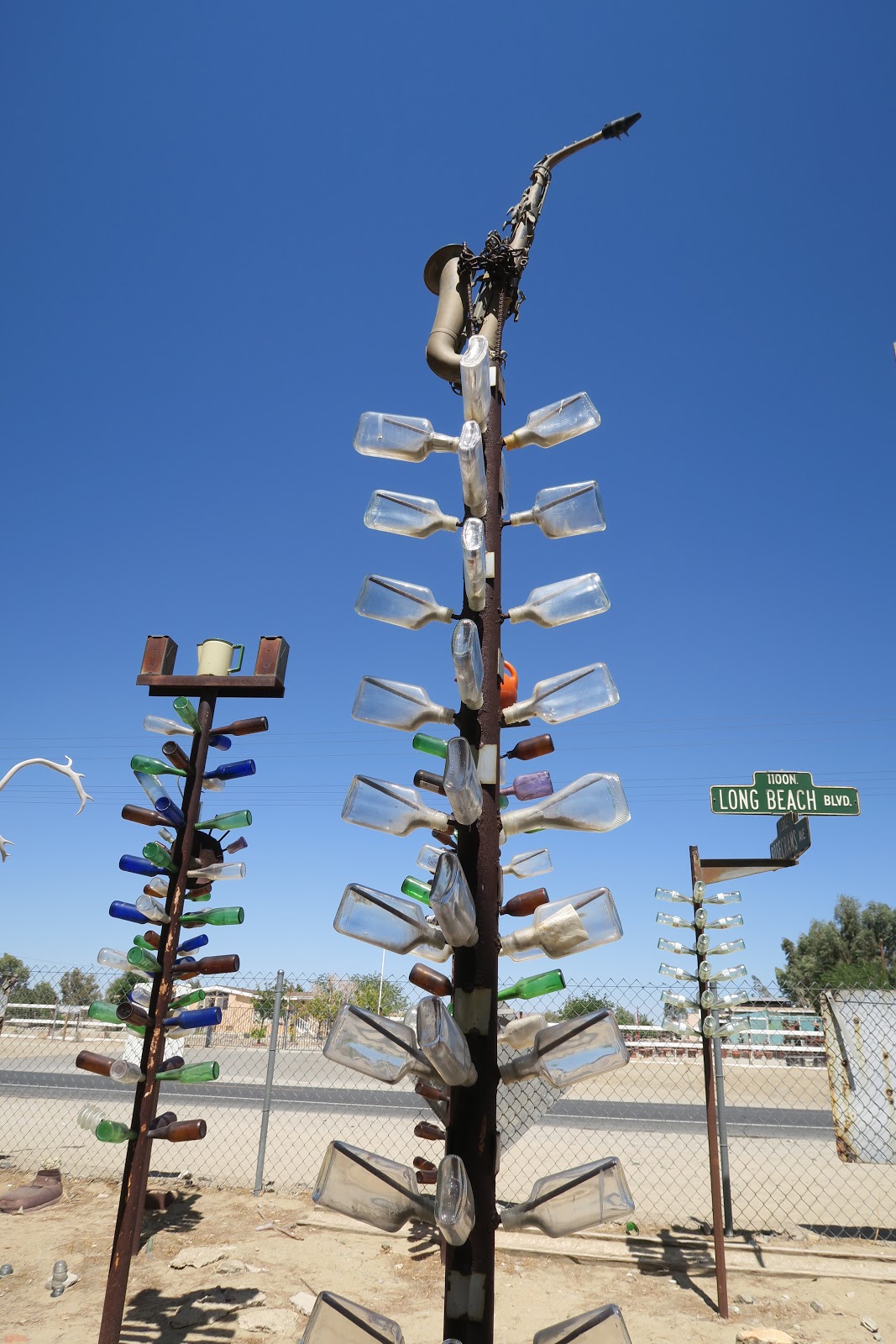
I looped down through Barstow to stop at a peculiar Route 66 destination that I had learned about from a friend: the Bottle Tree Ranch. I really cannot even explain what a Bottle Tree is, other than that it’s a metal stake in the ground with a bunch of metal stakes coming off of it like the branches of a tree and a bunch of bottles stuck on the ends of those like… well, like bottles on the end of a metal stake, I guess.


I would definitely label this as one of the strangest kicks on Route 66. Like many other things on Route 66, I think it is just strange for the purpose of being strange. I really don’t know what possessed this guy to make this forest of “trees” otherwise. I suppose probably he made one, and then he went, “Well that looks kind of cool and I have more bottles and more rebar so… I guess I’ll just make more.” And then they all looked kind of the same, so he decided to ornament them with odd and interesting pieces at the top. You know, things like stoplights. And saxophones. And car doors. And hubcaps. And typewriters. Easy peasy, right?

This guy must really drink a lot of beverages


I spent a good half hour there, wandering around while my confusion grew. Eventually I had had my fill of trying to find meaning in the trees, and Jane and I took off again, this time headed north.


A short jaunt later and we had arrived at Red Rock Canyon State Park. There are several Red Rock Canyon parks in the States, the most notable of which is just outside of Vegas. But this one is infrequently mentioned and even more infrequently visited, which makes it perfectly my speed.

The park is another example of a geological marvel with a surprisingly simple story. It reflects the history of an ancient lake that periodically flooded, dried up, and experienced riverine or even volcanic rock influx. Silty, muddy soft layers of rock deposited in the lake are interspersed with hard coarse sandstones and thick volcanic beds, which have prevented the complete erosion of the softer layers after recent exposure. Cliffs hundreds of feet tall show this relationship beautifully, with shelf-like sandstones protruding from the eroded-back muddier layers that seem to flow even when dry, reflecting water-driven erosion.


Jane and I arrived at the campground mid-afternoon and found that it was absolutely perfect. Far from the campgrounds that are typically placed in out-of-the-way spots, RRCSP’s campground clings to the base of one of the more spectacular outcrops in the park, offering sites blessedly shaded and protected from the elements by the cliffs themselves. The campground itself is massive, spreading for nearly a mile along the cliffs, so it was easy for Jane and I to find a nice secluded spot where there were no other human beings in sight.


View looking out from the campsite away from the cliff.

I wandered a good ¾ mile hike down to the visitor center, only to find that it was closed on Wednesdays and Thursdays. Good thing I got there on a Wednesday! Fortunately, they had left a bunch of brochures laying about, so I was able to lay eyes on the park map. Unfortunately, it was not terribly helpful in the advice department. I eventually wrangled my way into some wifi and was able to look up hiking trails in the park. A surprising amount were off-road-only trails meant more for Jeeps than for hikers. But I found a few that would be sure to provide awesome views for someone on foot.

Since I had quite a few hours of daylight left, I went ahead and tackled the loop right off of the campground. There were a lot of tracks wending their way across the top of the campground cliffs and out to overlooks across the canyons, so I took my time and visited them all.


Jane for scale


The black layer on the left is a volcanic flow that entered the lake - more muddy lacustrine layers were deposited on top of this, but have been eroded here

A cute horned lizard

The sun hung low in the sky by the time I was out of trail, so I headed back to camp and set up my normal Boy Scout meal routine. As night fell I found that absolutely no lights were visible from anywhere in my campsite – not even far off in the distance. The stark contrast from the dazzling flashing lights of Vegas was more than welcome. For me, peace is more often found in the wheeling of the stars overhead in a velvety black sky. And so the night slipped away with me laying on top of my picnic table, thoroughly enjoying the turning of the world and nothing more.

Kelly signing out.

Sunday, June 10, 2018

Bullheaded (and glad for it)


6/5/2018

I am well known for being more than a little bullheaded about strange things. Generally I’m a pretty easygoing human being, but I don’t take too well to being told what I can’t do.

So that’s why when the ranger this morning said, “You absolutely should not go hiking in the Valley of Fire today, it is supposed to be 111*F and the reflection of the sun off of the sandstone will bake you like a potato, DO NOT HIKE TODAY,” I suddenly had this urge to go hike every trail in the park.

Now, I’m not condoning this. As a former park service employee, I must advise you to always hike well within your limits. The last thing that you want is to be another blurb in the news.

But given that I had just spent a few days surviving the 120*F+ interior of my vintage car for hours on end with no respite and without resorting to using the AC, I felt that I had proven to be quite heat resistant and that hiking would probably be just fine for me.

And so I marched (well, drove) right up the road past the visitor’s center towards the heart of the Valley of Fire, intending to hike every trail in the park before midafternoon. 

At first, the road wound its way through a narrow canyon, massive deep red rocks looming close on all sides.


But then suddenly I rounded a bend, and the valley opened up in front of me. I was not at all prepared for the kaleidoscope of colors displayed in the myriad of craggy rocks and low hills in the valley. Where I had expected to continue to see deep red rocks, I instead saw hues of purple and orange and red and gold, all swirled together in fantastic patterns by the erosion of millennia. This place is beyond anything I’ve ever seen.


Just a little car in a big, big world 


Eventually I found myself on the trail to the Fire Wave, Valley of Fire’s most famous sandstone formation. Fortunately, the rangers’ strong suggestions had warned everyone else off of the trail, so I was alone save for one other hiker. Temps were in the mid 90’s (and climbing, I suppose), and a smart breeze skidded across the rocks, lifting heat and fine dust into the air. In other words, I thought that it was very nice out and that it was quite a pleasant time for a hike.

This sign disagrees.

The trail to the Fire Wave is not a long one – only ¾ of a mile or so. I wound my way through the reds and oranges and purples of this place, feeling almost in a different world. I didn’t see any animals save for a few lizards – I guess the heat warded the rest off. The near-perfect silence was sublime.

Pictured: a couple of lizards.


 At the end of the trail, I came upon a fascinating sandstone knob with swirls of red and purple and white twirling about it in a fanciful way. Spectacular.


One would expect that the geological story of such a crazy looking outcrop would be complex. But far from it, this particular rock’s swirling waves of color are entirely a result of the angled and varied erosion of flat-lying sandstone layers, each a different color. When eroded back at an angle, a thin bed may appear elongated and “smeared”. It is entirely fortune, then, that this rock was eroded in such a spectacular way. And that kind of makes it even more special.

After poking around the Fire Wave for a bit, I moved on to the next trail: White Domes. There, I saw the much more craggy end of the valley, with rocks thrown up into disarray by the faulting and folding that created the valley. I have to admit that it did not impress when compared with the Fire Wave, though it would have been very impressive had I seen it first.

 
I did see a cool rock shaped like a fish scale though.


From there I moved back down south along the road and briefly hiked the Rainbow Vista trail, which showcased the sandy valley floor and some more varied outcrops. Finally, I ended up on Mouse’s Tank, a trail that ended at a natural “tank” – a divot in the valley surrounded by large rocks that naturally funneled and retained water. But the tank wasn’t the part of the trail that I was most interested in. No, this trail’s wealth lies in the abundance of petroglyphs carved into the desert varnish along the canyon trail. Where normally you see petroglyphs carved in small groups, here hundreds would appear on the same rock, often overlying each other as if the ones who carved them had too much to say to fit in the available space.


No petroglyphs here, just a funky skinny huge slab of rock standing upright.


It is awe-inspiring to look on petroglyphs and consider the people who lived here before. Though now we have abundant food, water, and air conditioning available at our fingertips, rangers still must warn us against hiking in hot temperatures for fear of injury. But back when these petroglyphs were carved, none of those things were available. Water was scarce, food was limited mostly to lizards, and air conditioning was found in the form of a shaded overhang. And yet still people lived here, finding some worth in it. Imagining their tenacity makes me feel more than a little lame.

But even that slight feeling of shame did not overwhelm my reluctance to camp out another night. While I had intended to stay in the Valley of Fire for two nights, I found that I had hiked every open trail by early in the afternoon. The prospect of going back to my campsite to sit in the 111*F heat for hours waiting for nightfall did not appeal to me. Worse, last night had been dreadfully hot until the early hours of the morning – I had checked the temperature at 11PM, and it was still 93*F! I can sleep in that kind of heat, but it’s really just unpleasant.

So I hopped in Jane and scooted off to Vegas, where I took advantage of the $17 room special at Circus Circus, had a nice steak, and sat in the air conditioning comfortably. My ancestors would have been jealous.

Kelly signing out.